Thursday, March 17, 2016

Engine room 2

Have been out sailing from time to time in the Investigator and Fatty Knees. Went on 3-day cruise in Teria (link to the beginning click "newer posts" to see whole trip) and learnt a bit more about logistics and cruising.

It's helped to decide which way to go with the wylos engine. I have been interested in the electric auxillary concept but lately have swung back in favour of a diesel.

Teria's cruises made me realize that a decent range is needed from an auxiliary engine. On the Palm Islands trip I used about half my fuel but motored or motor sailed for many hours and at least 20 nautical miles. Sailing was done as much as possible but the lee side of the Islands had little wind. On the windward side the motor helped greatly and allowed higher pointing to windward and ability to clear the danger of a rocky lee shore quickly then get to safety and home on time. The downside was the outboard was quite noisy at times.

Townsville's Ross River is now a motor boat harbour thanks to a recent low level  bridge. .So it may be feasible to launch this wylo as a motor boat, where it can be moored cheaply upstream of the low bridge. then  finish the rig etc from a city base.

In this case the diesel engine would be the best solution.

Also set-up cost wise it would work out far cheaper initially than an electric drive probably about half to or quarter the price of all electric or a hybrid . no lithium battery pack (10k), few solar panels and no wind or auxillary genset costs (10-15k) required up front.
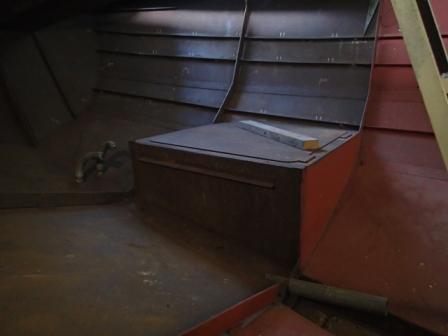
Aft Peak - cooling pipes, tank and stern tube (for propeller shaft)
 Already fitted - the keel cooling inlet and outlet pipes. The stern tube and a basic tank (without fittings). This is the space for the exhaust and cooling systems (plus stowage and quarter berth)


Aft peak under the cockpit and aft hatchway.


Wylo hull interior (taken from forepeak)

The main cabin looking aft. There's allot of space  Currently a  temporary work bench and some construction planks are in there.

I painted the interior with Metalfix  years ago and its held up ok. The cabin roof was also coated with metal fix then white king coat and that hasn't changed in the same time. It seems to hold corrosion well inside.

Monday, August 4, 2014

Wylo2 yacht register

The (now defunct) yahoo wylo2 group, posted an updated (2014) worldwide register of wylo 2 ' s. The numbers below are  changing as new info wylo's comes in.

About 45 wylo2's were reported launched and sailing.  Nine gaff rigged wylos were listed as under construction ashore

 Most Wylo2's are gaff rig, several are 2 mast junk rigged and one is Bermudan cutter rigged. Most are 32 footers and about a dozen are are 35 footers. 20 boats have full keels (FK 4'3" draft), 20 boats have centerboards (CB 3'3" draft), 3 boats have wing full keels (WK 3'9" draft).

In the 35 foot full keel gaff class, similar to my hull, there are only 9 sailing in the world. Most 35's are in the UK.

In Australia/NZ there are approx 13 wylo's. There are 8 wylos built in Australia. 6 are 32' CB gaffers, one is a 35 FK bermudan  In NZ there are four 32 ft CB gaffers and one 35 foot wing keeled gaffer operating. 35 footers are rare south of the equator. A 35 ft FK gaffer (Ironbark) built in Queensland, sometimes stays in NZ and spends most of her time  in many destinations around the world.

As for auxillary engines most are diesel of 14-30 HP. A few may be petrol. several UK wylos have hybrid engines and one from Canada has a Thoosa 9000 electric motor fitted.


Wednesday, July 9, 2014

Cruising yacht books 2

May as well start with the sailing-type books in the wyloyard's bookshelf as some boat-builders are probably also sailing in an affordable way already.

"Sensible cruising - The Thoreau approach" by Don Casey and Lew Hackler. A must read before embarking on any sailing venture.. It goes into the economics of cruising yacht ownership early on. In fact i wish i had read this book before starting to attempt to build a large yacht, life would have turned out very differently now, allot more sailing would have been done and some of the dreamed of places may have been visited.


At any one time we only have x-amount of finances and earning capacity, so at that time which could be now, the finances are weighed up and a much smaller boat than what was dreamed of can be bought so that the dream can become reality.  The cruising goals can be downsized at first, how about a coastal cruise to some offshore Islands near home instead of the Tahitian Islands? That mind-shift shaves decades off the dream to reality time for most of us. (Later you can get the bluewater cruiser). Allot of other practical things about yacht set-up and management are also covered. Thoreau discovered the magic of the wilds in a small canoe, this mindset works wonders. I applied the philosophy and bought a Fatty knees 8 sailing dinghy cheaply and found many "walden ponds" are right there under our noses. An even cheaper first craft could be an old kayak. Casey and Hackler talk about "micro-cruisers", keeled craft in the 24 -28 foot range but this can be downsized to trailer-sailers/yachts in the 16-22 foot length range, light enough to be tow-able behind a medium-large car. There is also another category of "beach cruiser" - a light displacement open dinghy for sail camping in the 13-16 foot length range tow-able behind a small car

A cruising guide book is invaluable where-ever you are based. For this part of the world a popular guide is "Cruising the coral coast" by Alan Lucas. This is an authoritative cruising guide to the Queensland coast which first came out in 1968 has been reprinted many time since  and can be found on the book shelves of many boating supply stores in Queensland. I used the book on-board Pablo in 1989. More info here. Lucas also authors  "Cruising the NSW Coast" which was on Pablos bookshelf for the voyage along that open stretch of water in the Tasman Sea. The guides are available from boatbooks or most boat chandlers in Australia. Updates for both guides on Alan Lucas's book website - (Look for the wylo2 which features in  logo top left ;-)

Thursday, February 13, 2014

Cruising yacht books

I accumulated a few books about sailing, cruising and boat-building over the years.  Some of the first books bought were recommendations by Nick Skeates in his building notes. books were bought as they were required, to get the background and know the options before each stage of the job. Still there's no substitute for actual practical experience , whether it be through a job either paid or voluntary or a technical college night course.

A Bibliography list of some of my Book Titles is in the "Bookshelf" section down the right hand side bar of this blog.

I bought quite allot of my  books new through a company called "Boat Books". In the old days they seemed to have stores everywhere which was great as you could thumb through it before deciding to buy, but as the web evolved they closed down all the outlying branches, so now its just a few capital cities.  The local library is a bit lean on good specialized cruising books.

In Australia, one of our best known Authors is Alan Lucas, from his youngest days he's lived the life at sea he writes about. His illustrations are right to the point and shed allot of light on any cruising boat subject. His boat-building titles show economical ways to do things for those of us on a limited boat budget.  I have some of his books already but recently wanted a couple more relating to fitting out - cruising. However, allot of these are out of print.

Annie Hill's blog had a link to "Abe books", so checked it out but being a bit IT phobic and unsure of it  left it alone till now.  I recently googled the books i was after and one of the hits was to Abe books too. So tried it out, it seems to be a UK based website that searches for books worldwide and connects the seller to the buyer. Results can be sorted by prices, shipping costs are also included. I tried it and found 2 books i was after at well below a present day price, in this case i selected books from two small secondhand  bookstores in small towns in NSW, but there's a big choice of prices/shipping costs and origins from local to overseas like the US and UK too. So coughed up and Abe books system sent the order off to the sellers to post it out. Abe's site has an estimated delivery date and a book tracker too. Web based services like this and search engines have improved allot with more retailers etc getting on board (along with my c-literacy) over the last couple of years.

Wed 18th Feb, Received my 2nd hand book "Fitting out below decks" by Alan Lucas, a couple of days ago. It was safely wrapped in postbag, cardboard, paper and inner waterproof bag. Just as well as the monsoon is in full swing here. The book was in near perfect condition with the dust cover 100%, and it's a good read for the uninitiated with many illustrations.

The 2nd book "Fitting out above decks" arrived soon after. It's also a hardback in very good condition. A treasure trove of ideas and ways to do things. He even has a page on the most practical type of fishing gear to carry.

Sunday, February 9, 2014

Shed extension #4

Just finished the NE shed roof extension #4. It is about 8 x 13 ft in area. The sturdy frame ran directly off the low workshop roof and 3 good sized corrugated sheets covered it. Tek screwed every 2nd corrugation to fasten.

Extension # 4 framework. 
The beam is recycled hardwood 5"x 2" about 14 ft long. The purlins are recycled and new galvanized steel top hat.
Framework from north roof


Cyclone Dylan was heading for us on the 30th Jan, so battened down the wyloyard and home in preparation for it. (Astronomical King tides of about 4 m were happening too, so any storm surge would have had a big effect if the timing was coincident) The port of Townsville was cleared with all big ships steaming out to sea before it reached land. However overnight Dylan changed course, intensified to Category 2 and veered southwards to cross near Bowen on a low tide. It hammered in from seaward and Hamilton Island in the WhitSundays experienced 120 km/hr winds plus some damage. At Airlie Beach a few yachts broke off their moorings, with one 28 footer becoming a total loss. As Townsville was were north of the eye, we were in the navigable semi-circle, and experienced only 25-40 knot winds coming from the SW and minimal rain..the wind had to cross hundreds of km of land mass to reach us so got weakened by that.


After the cyclone all clear, i returned to make a hinged shutter window on the wall below extension #4. It is simply a corrugated iron sheet set horizontally, with two hardwood beams 3 x 1" across at each end. Two pivots were made of 10 mm threaded rod going through 12 mm holes drilled through the upright poles. 60 cm rods hold it up at each end in the open position to let the breeze into the workshop area. A fern garden just outside helps the natural cooling effect, it felt like having about 2 fans going. It drops down quickly to control temperature, if the winds too strong, at night or in driving rain squalls. It is tek screwed onto the upright posts to hold it fast in cyclones.

Finished extension with ventilation shutter and irrigated fern garden

Ventilation shutter from inside shed's workshop area
I first came across horizontal shutters on Manihiki Atoll in the Cook Islands in the 1970s, Many houses there had wide eves, lower walls about 1 m high then horizontal shutters above these. (no glass windows at all) The shutters were made of 3" x 2" pine frames, galvanized nails and masonite, then painted. A bolt each side for the pivots which were placed about 1/3 down from the top to give some balance. Inexpensive but quite effective.